All cells in the body require oxygen. If someone’s lungs are unable to get sufficient oxygen on their own for some medical reason, supplemental oxygen is required. This is where an Oxygen Concentrator Works perfectly well by ensuring the constant supply of oxygen enriched air without the need of oxygen cylinders. Oxygen Concentrator is one of the most reliable medical devices for home and hospital use whether for respiratory disease sufferers or after surgeries or even long-term oxygen needs.
You will find out in this guide how an oxygen concentrator functions, what it consists of, the advantages it provides, its applications, and what to consider when purchasing or renting an oxygen concentrator.
What is an Oxygen Concentrator?
An Oxygen Concentrator Machine is a medical device that can remove oxygen from the ambient air, remove nitrogen and provide high-density oxygen to the recipient. Concentrators continuously generate oxygen as long as there is power, instead of a limited supply like oxygen cylinders.
The ambient air has a concentration of about:
- 78% Nitrogen
- 21% Oxygen
- 1% Other gases
An oxygen concentrator is a medical device that uses advanced filtration technology to extract oxygen from nitrogen, and provides oxygen in about 90%-96% pure.
How an Oxygen Concentrator Works
Knowing how an Oxygen Concentrator Works can be made much easier to understand by breaking it down into steps.
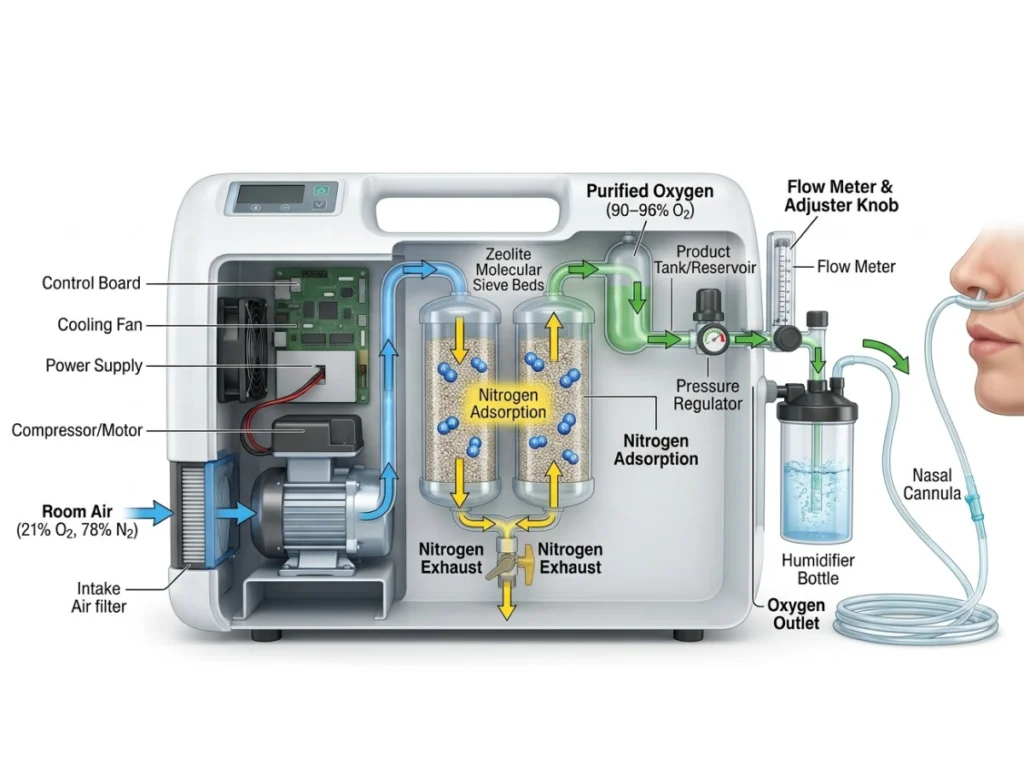
Step 1: Air Intake
First, the machine draws the normal room air through the external air filter. The filter traps the dust, dirt, pollen and airborne particles prior to their entry to the inside system.
Clean air guarantees improved oxygen purity and guards the inside components from harm.
Step 2: Air Compression
The filtered air is fed into a compressor.
Compressor boosts air pressure prior to feeding it to the molecular sieve beds. The efficiency of the oxygen separation is enhanced by pressurized air.
Step 3: Nitrogen Separation
This is the most important process within an Oxygen Concentrator Machine.
Two cylinders, each containing Zeolite molecular sieves, are used to compress the air.
These sieves are made with very small holes that only N2 molecules can fit into and oxygen molecules can fit out.
This gives a very high concentration of oxygen.
Step 4: Oxygen Collection
When the N2 is removed, O2 builds up in a storage tank.
The level of purity of most modern oxygen concentrators is around 90%-96%, based on the flow rate.
Step 5: Oxygen Delivery
The purified oxygen is then provided to the patient via:
- Nasal Cannula
- Oxygen Mask
Flow rates are modified to fit doctor’s prescription.
Common flow rates are:
- 1 LPM
- 2 LPM
- 3 LPM
- 5 LPM
- 10 LPM
Step 6: Nitrogen Release
The nitrogen gas is released into the atmosphere in a safe manner.
The machine alternates between two sieve beds continuously, ensuring an uninterrupted oxygen supply.
This is a process that continues on and on, every few seconds.
Main Components of an Oxygen Concentrator
Knowing the major components will help to understand how an Oxygen Concentrator Works.
Air Filter
Cleans and guards inside parts.
Compressor
Compresses room air prior to oxygen separation.
Zeolite Sieve Beds
Purify N2 from O2 by Pressure Swing Adsorption (PSA) technology.
Product Tank
Purified oxygen is temporarily stored before being delivered to the patient.
Flow Meter
Regulates the amount of oxygen supplied as required.
Humidifier Bottle
Moistens oxygen to reduce dryness in the nose and throat.
Control Panel
Allows users to adjust settings and monitor alarms.
Also Read : How Sleep Apnea Symptoms Affect Your Overall Health
Pressure Swing Adsorption (PSA) Technology
Pressure Swing Adsorption (PSA) technology is the type of technology used by most modern oxygen concentrators.
The process includes:
- Compressing room air
- Passing it through Zeolite sieve beds
- Capturing nitrogen
- Collecting oxygen
- Releasing nitrogen
- This appears to be a continuous process
PSA is a technology that enables continuous oxygen production without the need for tank replenishment.
Oxygen Purity
The majority of high-quality oxygen concentrators deliver the following:
| Flow Rate | Oxygen Purity |
| 1 LPM | 95–96% |
| 2 LPM | 94–95% |
| 3 LPM | 93–95% |
| 5 LPM | 90–93% |
Depending on the brand and the capacity of the machine, there may be variations in purity.
Types of Oxygen Concentrator Machines
1. Stationary Oxygen Concentrator
Designed for both home and hospital use.
Features:
- Higher oxygen output
- Continuous operation
- 5 or 10 LPM flow rate
- Requires electricity
Ideal for long-term oxygen therapy.
2. Portable Oxygen Concentrator
Portable Units are light and battery-powered.
Advantages include:
- Easy to carry
- Travel-friendly
- Battery backup
- Suitable for active users
Portable models are popular with many patients for their outdoor use and travel.
Who Needs Oxygen Therapy?
All those that have low levels of oxygen in their blood consistently are recommended oxygen therapy.
Common diseases are:
- COPD
- Chronic Bronchitis
- Pulmonary Fibrosis
- Pneumonia
- Asthma (severe cases)
- Check-ups for COVID-19 recovery (under medical supervision)
- Sleep Apnea with low oxygen levels
- Heart failure
- Interstitial Lung Disease
Doctors recommend Oxygen Therapy for patients with chronically low oxygen levels. Learn more about oxygen therapy from the American Lung Association.
Oxygen Concentrator Uses
Follow your health care provider’s directions for using oxygen therapy.
Home Oxygen Therapy
Supplies oxygen at home for long periods of time.
Hospital Care
Utilized in emergency rooms, ICUs and general wards.
Post-Surgery Recovery
Assists patients who have had a large surgery.
Elderly Care
Boosts oxygenation in elderly persons with chronic respiratory disease.
High Altitude
Can provide supplemental oxygen in high altitudes where necessary as indicated by medical conditions.
Palliative Care
Assists in making patients with serious respiratory diseases more comfortable.
Benefits of an Oxygen Concentrator
The Oxygen Concentrator comes with numerous benefits.
Continuous Oxygen Supply
Concentrators produce oxygen on an ongoing basis, as opposed to cylinders.
No Refilling Required
No need of oxygen tank refilling.
Lower Long-Term Cost
While the upfront price is more expensive, they can often have lower running costs.
Safe Operation
No high pressure oxygen storage, reduces certain handling risks as compared to cylinders.
User-Friendly
Easy to operate with simple controls.
Energy Efficient
The electricity used by modern machines is comparatively low.
Oxygen Concentrator vs Oxygen Cylinder
| Oxygen Concentrator | Oxygen Cylinder |
| Produces oxygen continuously | Stores compressed oxygen |
| No refill needed | Requires refilling |
| Uses electricity | Requires no power while operating |
| Lower running cost | Higher refill cost |
| More effective for long term use | In case of power outages or during travel |
Also Read : Choosing the Right CPAP Mask for Better Comfort Sleep
Choosing the Best Oxygen Concentrator
The best oxygen concentrator can be chosen depending on a number of factors.
Oxygen Flow Requirement
Choose:
- Most home users should use 5 LPM.
- If higher oxygen requirements (as prescribed) 10 LPM.
Oxygen Purity
Search for machines that keep the oxygen purity between 90-96%.
Noise Level
A quieter model provides better comfort levels when used for long periods of time.
Warranty
Longer warranties give higher levels of assurance.
Service Support
Ensure spare parts and maintenance are readily available.
Power Consumption
Machines that are energy efficient help operate saved electricity.
Oxygen Concentrator Price
The Oxygen Concentrator Price will depend on:
- Flow capacity
- Brand
- Portability
- Features
- Warranty
In India, the approximate price ranges are:
- 5 LPM models: ₹30,000–₹60,000
- 10 LPM models: ₹60,000–₹1,20,000
- Portable oxygen concentrators: ₹1,50,000–₹3,50,000+
Prices may be subject to change depending on the manufacturer, specification and offers from the dealers.
Oxygen Concentrator Rental
Buying isn’t always necessary. Oxygen Concentrator Rental comes in very handy for:
- Short-term illness
- Post-hospital recovery
- Temporary oxygen therapy
- Travel requirements
- Trial before purchasing
Benefits include:
- Lower upfront cost
- Maintenance often included
- Flexible rental periods
- Quick availability
- Accessibility of various machine capacities
Maintenance Tips
Maintenance enhances machine life and performance.
Clean Filters Regularly
Clean reusable filters as per the manufacturer’s instructions.
Keep Proper Ventilation
Ensure proper clearance around machine to allow for air movement.
Replace Accessories
Replace nasal cannulas and tubing as directed by health care professional.
Avoid Blocking Air Vents
Do not wall mount or mount against curtains.
Schedule Servicing
Regular inspections ensure the best oxygen purity and performance.
Safety Precautions
When someone is using an oxygen concentrator, follow these safety precautions:
- Avoid smoking in the vicinity of the machine.
- Do not put near lighted areas or heaters.
- Maintain adequate ventilation of the room.
- Do not use any accessories which have not been approved.
- Do not place on an uneven or unstable surface.
- Follow your prescribed oxygen flow rate.
- Never change the settings without consulting your health care provider.
Common Myths About Oxygen Concentrators
Myth 1: An oxygen concentrator generates oxygen.
Fact: They don’t produce oxygen. They extract oxygen from the air around them.
Myth 2 is always wrong: More Oxygen is Always Better.
Fact: In some people, too much oxygen can be a bad thing. Do not use more or less than the prescribed flow rate.
Myth 3: Oxygen Concentrators Must be Refilled.
Fact: They generate oxygen from air all the time and don’t need to be recharged.
Myth 4: They Are Only for Hospitals
Fact: There are actually several concentrators designed for safe and convenient home use.
Conclusion
So, knowing about the Oxygen Concentrator Works will help patients and caregivers make informed decisions about oxygen support. An Oxygen Concentrator Machine is an effective source of supplemental oxygen for people who require Oxygen Therapy, bringing in room air, filtering impurities, separating the nitrogen using Pressure Swing Adsorption (PSA) technology and providing oxygen rich air. Whether you’re comparing the Oxygen Concentrator Price, looking for the Best Oxygen Concentrator, considering Oxygen Concentrator Rental, or learning about various Oxygen Concentrator Uses, choosing the right device should always be based on your healthcare provider’s prescription, your oxygen requirements, and access to dependable service and maintenance. Contact Us Today!
Frequently Asked Questions
1. How does an Oxygen Concentrator work?
It sucks in air from the room, filters it, absorbs the nitrogen with Zeolite molecular sieves and provides oxygen-enriched air via a nasal cannula or a mask.
2. What is the advantage of an oxygen concentrator over an oxygen cylinder?
A concentrator is more convenient for many who need long-term oxygen support as it can continuously generate oxygen. In the event of a power failure or when transporting, oxygen cylinders can still be used.
3. May be used continuously with an oxygen concentrator?
Some stationary models can be used longer, but always use these machines as directed by the manufacturer, as well as your doctor’s recommendations.
4. Does the oxygen concentrator instantly raise the level of oxygen?
It starts to provide oxygen at operating purity and its blood oxygen increases as per the individual and should be monitored as per medical guidance.
5. What is the benefit of renting oxygen concentrators?
Yes, in many cases it makes sense to rent a machine for short-term therapy, recovery after hospital stay, or to take it for a test drive before buying.