Good sleep is key to good health, both physically and mentally. But many individuals have sleep-related issues like loud snoring, pauses in breathing, sleepiness during the day, headaches during the morning and trouble staying asleep. These symptoms can be a sign of a sleep disorder, such as obstructive sleep apnea (OSA).
Sleep study test is used to learn more about what happens during sleep. It captures various bodily functions and activities including breathing patterns, oxygen levels, heart rate and, depending on the test, brain activity.
Two popular sleep study options that are often discussed when it comes to sleep studies for diagnosing sleep-related breathing disorders are the Level 2 sleep study and the Level 3 sleep study.
Though, how are they different? Which test would you choose to use? Are both tests available for home use?
In this guide, you will learn the difference between Level 2 vs Level 3 sleep study, learn how sleep studies are conducted, the procedures involved, as well as benefits and differences.
What Is a Level 2 Sleep Study?
A Level 2 sleep study is a full sleep test that records various bodily systems during sleep. It is like an attended polysomnography lab test in the parameters it records, but can be conducted in some settings without a continuous presence.
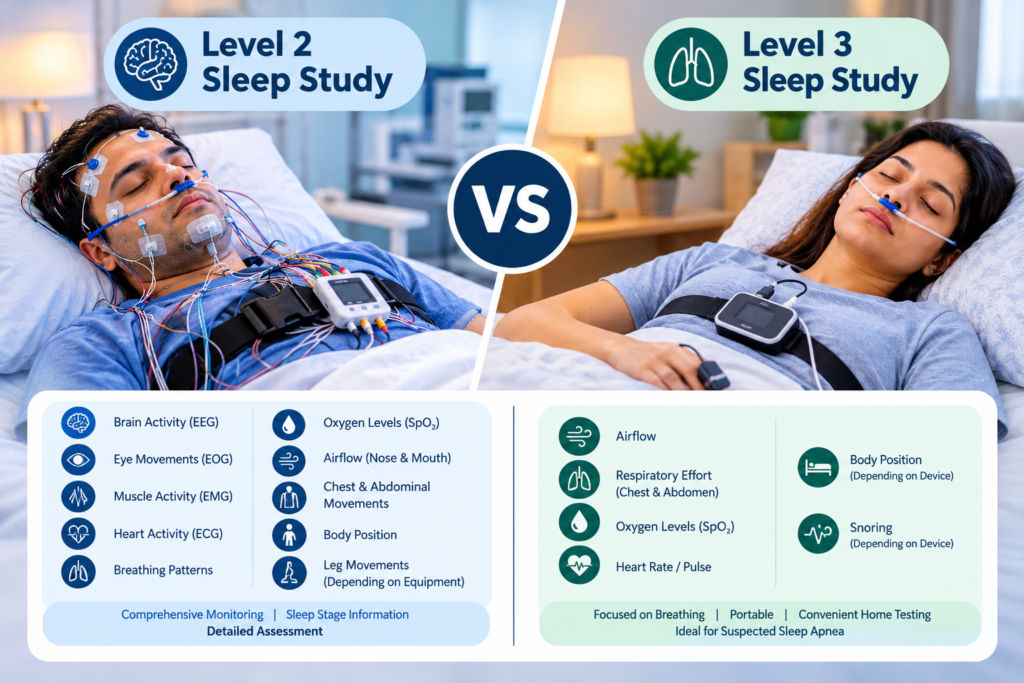
Generally, a Level 2 sleep study records:
- Brain activity (EEG)
- Eye movements (EOG)
- Muscle activity (EMG)
- Heart activity (ECG)
- Breathing patterns
- Blood oxygen saturation (SpO2)
- Nose and mouth breathing
- Chest and abdominal movements
- Body position
- Movement of the legs (according to equipment)
The recorded data enables trained health care professionals to evaluate sleep stage, breathing defects, oxygen fluctuations and other sleep abnormalities.
Benefits of a Level 2 Sleep Study
- Comprehensive monitoring: Keeps track of multiple physiological measurements throughout sleep.
- Sleep-stage information: EEG and eye movement recordings are used to determine the various sleep stages.
- Detailed assessment: May be able to help assess sleep apnea and other suspected sleep disorders.
- Home testing option: Some Level 2 systems are available for use at home, with appropriate clinical supervision.
- Useful diagnostic information: Gives a bigger picture of sleep patterns and physiological activity.
A Level 2 test can be suggested if a more detailed evaluation of sleep is needed. This decision may be based on the patient’s symptoms and clinical evaluation.
What Is a Level 3 Sleep Study?
A Level 3 sleep test is a portable sleep study that is mainly used to assess sleep-related breathing problems, specifically obstructive sleep apnea.
A Level 3 sleep study is not a comprehensive sleep study and does not involve EEG (brain activity) recording, unlike a Level 2 sleep study.
It typically tracks at least four channels such as:
- • Airflow
- Respiratory effort (chest and abdominal movements)
- Blood oxygen saturation (SpO2)
- Heart rate or pulse
Depending on the device, it can also be used to capture body position and snoring.
The home sleep apnea test (HSAT) is typically a level 3 sleep study that is performed at home for a specific type of patient who has suspected obstructive sleep apnea.
Benefits of a Level 3 Sleep Study
- Convenient home testing: May be done at home in a familiar setting.
- Portable equipment: Monitoring equipments are typically light and easy to move.
- Breathing assessment: Identifies breathing pauses and changes in oxygen levels during sleep.
- Less complex setup: Typically fewer sensors than Level 2 test.
- Useful for suspected sleep apnea: May help to evaluate obstructive sleep apnea in appropriate patients.
Not all patients will have a Level 3 test. Depending on the clinical findings, a negative/inconclusive result may warrant further testing, including in-lab polysomnography testing.
Level 2 vs Level 3 Sleep Study: Key Differences
The two tests measure sleep related activity but they record and utilize them in different ways.
| Comparison | Level 2 Sleep Study | Level 3 Sleep Study |
| Type of test | Comprehensive sleep monitoring | Limited-channel respiratory monitoring |
| Brain activity (EEG) | Yes | Generally no |
| Eye movements | Yes | Generally no |
| Muscle activity | Yes | Generally no |
| Airflow monitoring | Yes | Yes |
| Oxygen monitoring | Yes | Yes |
| Respiratory effort | Yes | Yes |
| Heart rate | Yes | Yes |
| Sleep-stage assessment | Possible | Not directly measured |
| Home testing | Possible | Commonly used |
| Main application | Detailed sleep assessment | Suspected sleep-related breathing disorders |
Note: This may vary depending on the equipment and test protocols. Typical Level 2 and Level 3 configuration are described in the table.
Level 2 vs Level 3: Which Sleep Study Is Better?
There is no one right answer as it will depend upon which test is indicated based on patient symptoms, medical history and clinical needs.
When Is a Level 2 Sleep Study Recommended?
Considered to be a level 2 sleep study if:
- A comprehensive sleep stage analysis is needed.
- A doctor thinks the person may have a complex sleep disorder.
- More detailed physiological monitoring should be provided.
- Previous home sleep apnea test was negative or inconclusive, and symptoms are still present.
- There is a need for more information on sleep-related activities.
When Is a Level 3 Sleep Study Recommended?
Considered when:
- Someone complains of symptoms of obstructive sleep apnea.
- Home sleep apnea testing is recommended by a health care provider.
- The patient is a suitable patient for portable respiratory monitoring.
- Breathing pauses and oxygen levels should be monitored while sleeping.
Only a qualified health care professional should make the final decision. A level 3 test should not be routinely used in place of a thorough sleep test in situations where more detailed assessment is needed. Learn more about sleep studies and how they help diagnose sleep disorders.
How Is a Sleep Study Test Performed?
The process varies for the different tests and equipment. The general principle of both Level 2 and Level 3 tests is to place sensors on the body and collect physiological data throughout sleep.
Let’s take a look at how it works.
Step 1: Initial Assessment
The patient’s symptoms, sleep history and medical information are reviewed by the healthcare professional to decide which test is appropriate.
Step 2: Equipment Setup
The patient is issued the monitoring equipment and how to use it. Sensors can be fixed to the head, face, chest, abdomen, finger or legs, depending on the test.
Step 3: Overnight Monitoring
While the patient sleeps, the required information is recorded by this device. The equipment is typically used overnight for home testing and is used as per the instructions given by the provider.
Step 4: Equipment Return
Equipment that is rented or appointed will be returned to the testing provider at the end of the monitoring period.
Step 5: Report and Interpretation
Data is analysed by appropriate competent staff. Healthcare worker discusses results and what is to be done next.
The procedure may vary depending on the device, testing provider and clinical requirements.
Can Level 2 and Level 3 Sleep Studies Be Done at Home?
Yes. If appropriate, sleep studies can be performed at home at either Level 2 or Level 3.
Home Level 2 Sleep Study
A home level 2 sleep study involves a full monitoring machine that has several sensors. The patient uses the equipment at night, according to the instructions given by the testing person.
It captures brain activity, eye movements, muscle activity, breathing patterns, oxygen levels and other physiological parameters as appropriate to the device.
Home Level 3 Sleep Study
A home sleep study is one of the most frequently performed sleep studies to diagnose suspected obstructive sleep apnea. It generally involves a portable monitoring device with sensors for airflow, respiratory effort and oxygen saturation.
The patient can sleep in their normal home environment, and the information that is required is collected.
Why Choose a Home Sleep Study?
There are several benefits of home testing:
- Sleeping in a comfortable place.
- Testing without the need for overnight hospitalisation.
- Portable monitoring equipment.
- Less disturbance of the normal sleep pattern.
- Appropriate choices for patients who are appropriate.
But, home testing is not suitable for all people. Your health care provider will determine which type of sleep study is best for you: home or laboratory.
Also Read: Oxygen Concentrator on Rent: Price, Models & Home Delivery
Difference Between a Sleep Apnea Test and a Polysomnography Test?
Typically speaking, a sleep apnea test is a test for sleep apneas. One commonly performed home sleep apnea test is a Level 3 test.
A Polysomnography test (PSG) is a complete sleep test that monitors multiple physiological functions (brain activity, eye movements, muscle movement, breathing and oxygen levels).
The main difference is the amount of information collected.
- Sleep apnea test: Primarily evaluates abnormalities in brain wave activity.
- Polysomnography test: This test is more detailed than the sleep test with a sensor and is used to better understand sleep and various physiologic events.
The best test will be used based on the symptoms and the healthcare practitioner’s judgment.
Symptoms That May Indicate the Need for a Sleep Study
Those who snore do not necessarily have sleep apnea. But some symptoms might be a sign of a sleep-related breathing problem.
If you have any of the following symptoms you may want to consider talking to a health care professional about a sleep evaluation:
- Loud and frequent snoring: If snoring happens a lot and is loud, it may be a sign of obstructive sleep apnea.
- Breathing interruptions during sleep: This is when breathing stops during sleep, which may be noticed by a bed partner.
- Gasping or choking at night: If they wake up suddenly and gasp for breath it can be a sign of breathing problems.
- Excessive daytime sleepiness: Daytime sleepiness despite adequate nighttime sleep.
- Morning headaches: If you have a sleep-related breathing disorder, you may experience headaches in the morning.
- Difficulty concentrating: Sleep quality may impact attention, memory and daily functioning.
- Unrefreshing sleep: Sleep that does not help to refresh.
When you have these symptoms, it is important to see a qualified health care provider to get a proper evaluation.
Also Read: Portable Oxygen Concentrator on Rent or Purchase in India
Sleep Study Services in Faridabad and Delhi NCR
A sleep study may be useful for your healthcare provider to explore the cause if you have symptoms like loud snoring, sleep difficulty, pauses in breathing while sleeping or sleepiness during the day.
SNK Global Consultancy Services offers information and support for sleep study arrangements, Level 2 and Level 3 sleep study options.
We want patients and healthcare professionals to be able to learn about the range of sleep monitoring options, and what equipment is involved.
Our Sleep Study Support
- Level 2 Sleep Study in Faridabad: Assisting with comprehensive sleep monitoring.
- Level 3 Sleep Study in Faridabad: Support for portable respiratory sleep monitoring.
- Sleep Study at Home in Faridabad: Home testing option (based on clinical suitability and availability).
- Sleep Apnea Test in Faridabad: Sleep apnea test arrangements help.
- Home Sleep Study in Delhi NCR: Details of home sleep study.
- Sleep Study Services in Delhi NCR: Assistance for patients looking for suitable sleep monitoring solutions.
How to Arrange a Sleep Study
The process is simple:
- Call SNK Global Consultancy Services or WhatsApp them.
- Let them know where you are and what you are booking.
- Talk about testing choices and machines.
- Follow the directions of the competent testing personnel.
- Ask a health care worker to check and explain your results.
It is important that the type of test be based on clinical assessment instead of convenience.
Conclusion
If considering a sleep study to diagnose sleep problems, it is important to understand the difference between Level 2 and Level 3 sleep study.
A Level 2 sleep study provides additional recording data such as brain activity and sleep stage information. A sleep study is mainly performed to monitor breathing (sleep apnea) in a patient who presents with symptoms of obstructive sleep apnea, and is a Level 3 sleep study.
When used and interpreted correctly, both tests can be useful.
If you or a family member has ongoing snoring, pauses in breathing while sleeping or excessive daytime sleepiness, seek advice from a healthcare professional about the need for a sleep study.
Need information about a Level 2 or Level 3 Sleep Study in Faridabad or Delhi NCR?
Talk to SNK Global Consultancy Services about sleep study options and home testing options.
Disclaimer: This article is intended to provide information only and is not a substitute for medical advice, diagnosis or treatment by a healthcare provider. Please seek advice from a “skilled health care professional” to decide which sleep test is appropriate. Contact Us Today!
Frequently Asked Questions (FAQs)
1. What is the main difference between Level 2 and Level 3 sleep study?
A Level 2 sleep study monitors additional parameters (brain activity, eye movement, muscle activity etc.). A Level 3 sleep study primarily records breathing, breathing effort, oxygen saturation and heart rate.
2. Is a Level 2 sleep study better than a Level 3 sleep study?
Both tests have their advantages and disadvantages. Level 2 is more detailed monitoring, while Level 3 is usually applied to patients who have been identified for obstructive sleep apnea (OSA) testing. This is to be decided by clinical needs.
3. Can I do a Level 3 sleep study at home?
Yes. Portable testing equipment is used at home to conduct level 3 testing. Patients need to follow the directions of the testing person.
4. Does a Level 2 sleep study record brain activity?
Yes. One of the common sleep studies performed at Level 2 includes EEG monitoring (electroencephalogram) that measures the brain activity and assists in diagnosing sleep stages.
5. How long does a sleep study test take?
The majority of sleep studies will have you sleep one night. The testing equipment and protocol are dependent on the duration.
6. Is a home sleep study accurate?
Home sleep study can be valuable for a subset of patients for proper diagnosis. But it doesn’t necessarily detect all sleep disorders. If the test comes back negative or inconclusive, additional testing might be needed.
7. Who should get a sleep apnea test?
Individuals who have snoring, have noted pauses in breathing, gasps during sleep or excessive daytime sleepiness should consult their healthcare provider to discuss whether they need to be tested.
8. Where can I arrange a Sleep Study in Faridabad?
For information and assistance in arranging a Level 2 and 3 Sleep Study in Faridabad and Delhi NCR, you can reach out to SNK Global Consultancy Services.